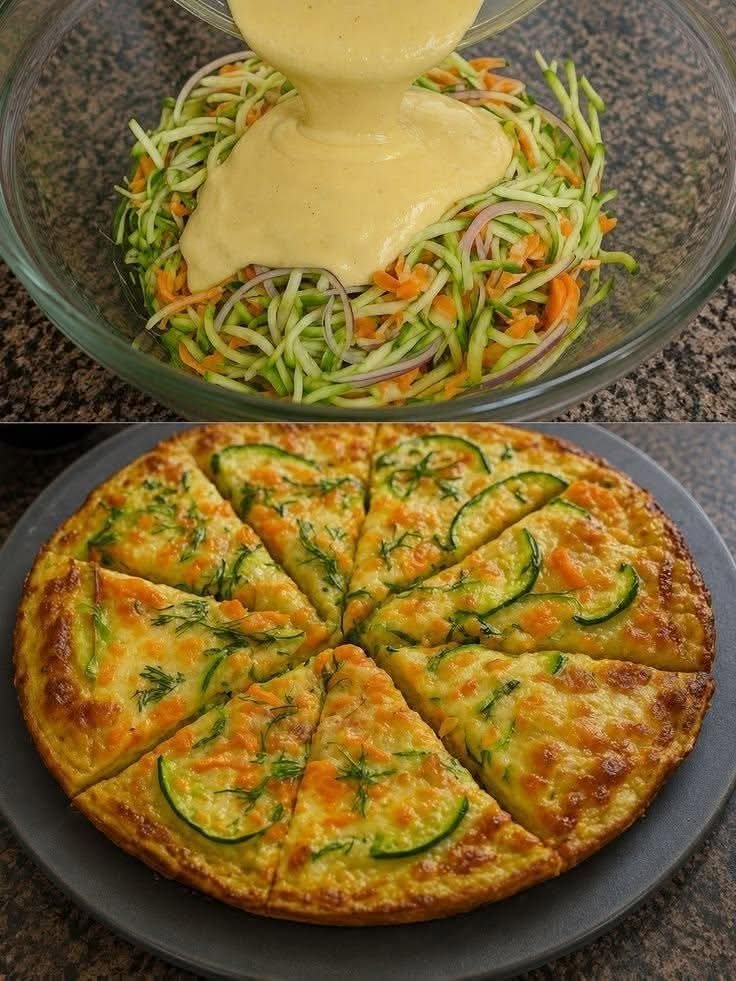
The dish in your photo looks like a baked zucchini and carrot vegetable frittata, prepared with shredded zucchini, grated carrot, red onion, eggs, cheese, and fresh dill. The vegetables are combined with a creamy egg mixture, then baked until the center is set and the top becomes beautifully golden.
It can be served for breakfast, brunch, lunch, dinner, or as a light vegetarian meal.
1. Introduction
This zucchini and carrot frittata is a simple, colorful, and nutritious dish that turns everyday vegetables into a delicious baked meal. The combination of zucchini and carrot gives the dish a naturally sweet and fresh flavor, while eggs provide the structure that holds all the ingredients together.
The preparation shown in the photo begins with finely shredded vegetables. A creamy mixture is then poured over them before everything is combined and baked. The finished frittata has a golden-brown surface, a soft and moist interior, and visible pieces of zucchini and carrot throughout.
Fresh dill is an excellent addition because its delicate herbal flavor works particularly well with zucchini and eggs. A little cheese adds richness and helps create the attractive golden crust.
The recipe is also very flexible. You can add other vegetables, herbs, or cheeses depending on what you have available.
2. Ingredients
For the vegetable mixture
- 3 medium zucchini
- 2 medium carrots
- 1 small red onion
- 2 tablespoons fresh dill, chopped
- 1 tablespoon olive oil
- ½ teaspoon salt
- ½ teaspoon black pepper
For the egg mixture
- 5 large eggs
- 120 ml milk
- 100 g grated cheese
- 3 tablespoons all-purpose flour
- 1 teaspoon baking powder
- ½ teaspoon garlic powder
- ½ teaspoon paprika
- ¼ teaspoon salt
- ¼ teaspoon black pepper
For the topping
- 50–70 g grated mozzarella or cheddar
- A few thin slices of zucchini
- Fresh dill
- A small amount of grated carrot, optional
3. Equipment
You will need:
- Large mixing bowl
- Medium mixing bowl
- Grater
- Knife
- Cutting board
- Whisk
- Rubber spatula
- 24–26 cm round baking dish or cake pan
- Baking paper
- Clean kitchen towel
- Oven
4. Preparing the Zucchini
Begin by washing the zucchini thoroughly.
Trim both ends.
Using a coarse grater, grate the zucchini into a large bowl.
Zucchini contains a considerable amount of water, so removing excess moisture is one of the most important steps in this recipe.
Sprinkle approximately ½ teaspoon of salt over the grated zucchini.
Mix gently and allow it to sit for about 10–15 minutes.
The salt will draw some moisture out of the zucchini.
Place the zucchini into a clean kitchen towel and squeeze firmly.
You want to remove as much excess liquid as possible.
This step prevents the finished frittata from becoming watery.
Do not skip it.
5. Preparing the Carrots
Peel the carrots.
Grate them using the same grater.
Unlike zucchini, carrots do not usually need to be squeezed because they contain considerably less water.
However, if the carrots are particularly juicy, you can gently press them to remove a little moisture.
Place the grated carrots into a large mixing bowl.
6. Preparing the Onion
Peel the red onion.
Slice it very thinly or grate it.
The thin pieces will soften during baking and distribute their flavor throughout the frittata.
Red onion adds a mild sweetness and attractive color.
If you prefer a more delicate onion flavor, you can sauté it in a small amount of olive oil for approximately 3–4 minutes before adding it to the vegetables.
Allow it to cool slightly before mixing it with the eggs.
7. Preparing the Dill
Wash the fresh dill and dry it carefully.
Remove the thicker stems and finely chop the leaves.
Add approximately two tablespoons to the vegetable mixture.
You can reserve a little dill for decorating the finished dish.
Fresh dill gives the frittata a fresh, aromatic flavor.
If you don’t have dill, you can substitute:
- Parsley
- Chives
- Basil
- Coriander
However, dill pairs particularly well with zucchini.
8. Making the Vegetable Mixture
Place the squeezed zucchini, grated carrots, and chopped onion into a large bowl.
Add:
- Fresh dill
- Black pepper
- A small amount of salt
- Paprika
Mix everything together.
Be careful with the salt because you already salted the zucchini during the moisture-removal process, and the cheese will also contain salt.
9. Preparing the Egg Mixture
Crack five eggs into a separate bowl.
Whisk them until the yolks and whites are completely combined.
Add the milk.
Whisk again.
Then add:
- Flour
- Baking powder
- Garlic powder
- Black pepper
- A small pinch of salt
Whisk until smooth.
There should be no large lumps of flour.
The mixture should have the consistency of a relatively thin batter.
10. Adding the Cheese
Add approximately 100 g of grated cheese to the egg mixture.
You can use:
- Mozzarella
- Cheddar
- Gouda
- Emmental
- Gruyère
For a mild flavor, mozzarella works very well.
For a stronger flavor, use cheddar or Gruyère.
Mix the cheese evenly through the egg mixture.
11. Combining Everything
Pour the egg and cheese mixture over the prepared vegetables.
Using a rubber spatula, mix everything together.
Make sure the egg mixture reaches all the vegetables.
The final mixture should be moist but not excessively liquid.
If it seems very watery, the zucchini probably still contains too much moisture.
In that case, you can add another tablespoon of flour.
12. Preparing the Baking Dish
Preheat the oven to approximately 180°C.
Take a 24–26 cm round baking dish.
Lightly grease the inside with olive oil or butter.
Place a circle of baking paper on the bottom if desired.
Greasing the sides will make it easier to remove the finished frittata.
Pour the vegetable mixture into the dish.
Spread it evenly using a spatula.
13. Decorating the Top
The photo shows attractive slices of zucchini arranged on top.
To recreate this presentation, take a small zucchini and slice it into very thin half-moon pieces.
Arrange the slices around the surface of the mixture.
You can create a circular pattern starting from the outside and moving toward the center.
Sprinkle a small amount of grated cheese over the top.
Add a few pieces of fresh dill.
This creates a beautiful golden and green appearance after baking.
14. Baking
Place the dish into the preheated oven.
Bake at 180°C for approximately 35–45 minutes.
The exact time depends on the depth of your baking dish and your oven.
The frittata is ready when:
- The surface is golden brown.
- The edges are firm.
- The center is set.
- A toothpick inserted into the center comes out without liquid egg mixture.
- The vegetables are tender.
If the top becomes brown too quickly while the center is still soft, loosely cover the dish with aluminum foil and continue baking.
15. Resting the Frittata
Once baked, remove the dish from the oven.
Do not immediately cut the frittata.
Allow it to rest for approximately 10–15 minutes.
During this time, the eggs will finish setting and the juices will redistribute.
This makes the frittata much easier to slice.
16. Cutting and Serving
Run a knife carefully around the edge of the dish.
Cut the frittata into triangular slices, just as shown in the photograph.
Use a spatula to transfer each piece onto a plate.
Garnish with fresh dill.
For an attractive presentation, serve each slice with:
- Fresh salad
- Cherry tomatoes
- Cucumber
- Yogurt sauce
- Garlic sauce
- A few fresh herbs
17. Simple Yogurt Sauce
A cool yogurt sauce works beautifully with this vegetable frittata.
Ingredients
- 150 g Greek yogurt
- 1 small garlic clove
- 1 teaspoon lemon juice
- 1 tablespoon fresh dill
- Pinch of salt
- Black pepper
Method
Combine all the ingredients in a small bowl.
Mix well.
Taste and adjust the seasoning.
Serve alongside the warm frittata.
The cool, slightly acidic yogurt sauce contrasts beautifully with the warm baked vegetables.
18. Cooking Method
The principal cooking method in this recipe is baking.
However, several preparation techniques are involved:
Grating
Zucchini and carrots are grated into small pieces so that they cook quickly and distribute evenly.
Moisture extraction
Salt is used to draw excess water from the zucchini.
Mixing
The vegetables are combined with eggs, flour, milk, cheese, and herbs.
Baking
The mixture is baked gently until the eggs coagulate and the frittata develops a golden crust.
Resting
Allowing the dish to rest after baking improves its texture and makes slicing easier.
19. Why Removing Zucchini Water Is Important
This is one of the most important technical points in the recipe.
Zucchini contains a lot of water.
If you grate the zucchini and put it directly into the egg mixture, the water can be released during baking.
This can result in a frittata that is:
- Watery
- Difficult to slice
- Too soft in the center
- Less flavorful
Salting and squeezing the zucchini removes much of this excess moisture.
The result is a firmer and more flavorful baked dish.
20. Tips for a Perfect Frittata
1. Squeeze the zucchini well
This is the most important step.
2. Don’t use too much salt
The zucchini, cheese, and seasoning can all contribute salt.
3. Use fresh eggs
Fresh eggs help produce a better structure.
4. Don’t overbake
Overbaking can make the eggs dry and rubbery.
5. Let it rest
Give the frittata 10–15 minutes before slicing.
6. Use a moderate oven temperature
Around 180°C provides enough heat to cook the center while allowing the vegetables to remain tender.
7. Add cheese on top
A small amount of cheese creates a beautiful golden crust.
21. Variations
Zucchini and Potato Frittata
Add one small grated potato. Squeeze it very well before mixing.
Zucchini and Spinach Frittata
Add approximately 100 g chopped spinach. If using frozen spinach, squeeze out the excess water.
Mediterranean Frittata
Add:
- Cherry tomatoes
- Feta cheese
- Olives
- Oregano
- Fresh basil
Mushroom Frittata
Sauté sliced mushrooms first to remove their moisture, then add them to the vegetable mixture.
Spicy Version
Add:
- Chili flakes
- Cayenne pepper
- Jalapeño
- Smoked paprika
22. Nutritional Benefits
This dish provides a combination of vegetables, eggs, and dairy.
Zucchini contributes water, fiber, and various micronutrients.
Carrots add beta-carotene and natural sweetness.
Eggs provide high-quality protein and help create the structure of the frittata.
Cheese contributes protein and calcium while adding richness.
Fresh herbs such as dill contribute flavor without requiring large amounts of salt or fat.
For a lighter version, you can reduce the cheese and use low-fat milk.
23. Storage
Allow the frittata to cool completely.
Place leftovers in an airtight container and refrigerate.
It can generally be kept in the refrigerator for approximately 3–4 days.
To reheat, place a slice in the microwave for a short period or warm it in an oven at approximately 160°C.
For the best texture, reheating gently is preferable to very high heat.
24. Serving Ideas
This vegetable frittata is extremely versatile.
Breakfast
Serve one slice with fresh fruit, tomatoes, and yogurt.
Lunch
Serve with a large green salad and whole-grain bread.
Dinner
Pair with roasted vegetables or a light soup.
Brunch
Cut it into small triangular pieces and arrange them on a serving platter.
School or culinary presentation
Place one triangular slice in the center of a clean white plate. Add a small salad on the side, a spoonful of yogurt sauce, and fresh dill as garnish.
25. History and Culinary Inspiration
Frittata is traditionally associated with Italian cuisine and is essentially an egg-based dish in which vegetables, cheese, herbs, and other ingredients are incorporated before cooking.
The technique has inspired many variations around the world. Unlike a folded omelet, a frittata is generally thicker and can be cooked slowly until the entire mixture is set.
This zucchini and carrot version takes inspiration from that style while using a generous amount of fresh vegetables.
The round shape shown in the photograph also makes it suitable for serving as a family-style dish, where it can be cut into attractive wedges.
26. Professional Presentation
For a professional culinary presentation, the appearance of the dish is almost as important as its flavor.
Use a dark or neutral serving plate to contrast with the golden frittata.
Cut the frittata into equal triangular portions.
Place the slices neatly on the plate.
Garnish with fresh dill.
Add a small amount of finely grated carrot or a few thin zucchini slices.
You can also place a small spoonful of yogurt sauce beside the slice.
The final color combination should include:
- Golden brown from the baked egg and cheese
- Green from zucchini and dill
- Orange from carrot
- White or pale yellow from the egg and cheese
This gives the dish a fresh and appetizing appearance.
27. Conclusion
This Zucchini and Carrot Vegetable Frittata is an easy, colorful, and versatile recipe that transforms simple vegetables into an elegant baked dish.
The key to success is removing excess moisture from the zucchini before combining it with the eggs. Once the vegetables are properly prepared, they are mixed with eggs, milk, flour, cheese, herbs, and seasonings. The mixture is then baked until the center is completely set and the surface becomes golden brown.
Fresh dill gives the frittata a pleasant herbal aroma, while cheese adds richness and creates a delicious golden crust. Thin zucchini slices arranged on top make the finished dish especially attractive.
The result is a soft and flavorful vegetable center with a golden, slightly crisp exterior, perfect for breakfast, brunch, lunch, dinner, or a vegetarian culinary presentation.
Final result: 🥒🥕 a golden baked zucchini and carrot frittata, filled with colorful vegetables, melted cheese, fresh dill, and a soft egg-based center—simple ingredients transformed into a beautiful and satisfying meal.