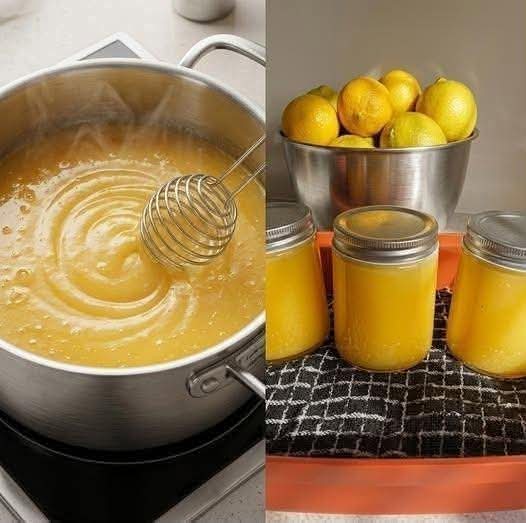
Introduction
There is something wonderfully bright and irresistible about homemade lemon curd. Smooth, creamy, silky, and bursting with fresh lemon flavor, this classic spread turns a handful of simple ingredients into something that tastes absolutely luxurious.
Unlike many store-bought versions, homemade lemon curd has a beautiful balance of sweet and tart flavors. It is delicious spread over toast, biscuits, scones, pancakes, waffles, or muffins, and it can also become the filling for cakes, cupcakes, pies, tarts, and pastries.
This recipe is simple enough for a beginner but impressive enough to serve at a special breakfast, afternoon tea, family gathering, or dessert table.
Ingredients
- 4 large fresh lemons
- 1 cup granulated sugar
- 4 large eggs
- ½ cup unsalted butter, cut into small pieces
- 1 tablespoon finely grated lemon zest
- ¼ teaspoon salt
- 1 teaspoon vanilla extract, optional
For the best lemon flavor
Use fresh lemons and finely grate only the yellow portion of the peel. Avoid the white pith underneath because it can make the curd bitter.
Instructions
Step 1: Prepare the lemons
Wash and dry the lemons thoroughly. Finely grate about 1 tablespoon of lemon zest.
Cut the lemons in half and squeeze them until you have approximately ½ cup of fresh lemon juice. Strain the juice through a fine-mesh strainer to remove seeds and excess pulp.
Step 2: Combine the eggs and sugar
In a medium saucepan, whisk together the eggs, granulated sugar, lemon zest, and salt.
Whisk until the mixture becomes smooth and the sugar is evenly incorporated.
Step 3: Add the lemon juice
Slowly whisk the fresh lemon juice into the egg mixture.
Place the saucepan over low to medium-low heat.
Step 4: Cook the lemon curd
Cook the mixture gently, stirring constantly with a silicone spatula or whisk.
Do not let the mixture boil. Gentle cooking is important because the eggs need to thicken gradually without scrambling.
After several minutes, the curd will begin to thicken. You will know it is ready when it coats the back of a spoon and leaves a clean path when you run your finger through it.
For extra accuracy, the curd should reach approximately 170–175°F (77–79°C).
Step 5: Add the butter
Remove the saucepan from the heat.
Add the butter pieces a few at a time, stirring until each piece melts completely before adding more.
The butter gives the lemon curd its wonderfully smooth, rich, creamy texture.
Stir in the vanilla extract if using.
Step 6: Strain the curd
For an exceptionally silky texture, pour the warm lemon curd through a fine-mesh strainer into a clean bowl.
This removes any tiny pieces of cooked egg or zest and leaves you with an incredibly smooth finished curd.
Step 7: Cool
Place a piece of plastic wrap directly against the surface of the curd to prevent a skin from forming.
Allow it to cool at room temperature for a short time, then refrigerate.
The curd will become noticeably thicker as it chills.
Method
The secret to beautiful lemon curd is gentle heat and constant attention.
The eggs provide the structure, while the lemon juice supplies the bright acidity. Sugar balances the tartness, and butter creates the rich, creamy mouthfeel.
Cooking everything slowly allows the eggs to thicken the mixture without becoming scrambled.
If you prefer an especially smooth curd, strain it before chilling.
Formation of the Lemon Curd
Lemon curd forms through a simple process of gentle egg coagulation.
As the mixture warms, the proteins in the eggs gradually thicken. The butter then blends into the mixture, creating a smooth emulsion. Once chilled, the butter firms slightly and the curd develops its characteristic spreadable consistency.
The result is a thick but creamy mixture that holds its shape while remaining soft enough to spread.
A Little History
Fruit curds have a long history in British and European cooking. Lemon curd became particularly popular in Britain as a tart, luxurious accompaniment for bread, scones, cakes, and afternoon tea.
Early versions were often prepared with lemon juice, sugar, eggs, and butter and cooked gently until thickened.
Over time, lemon curd became a beloved ingredient far beyond the tea table. Today it is commonly used in tarts, cakes, pastries, cheesecakes, cookies, pavlovas, and layered desserts.
Homemade lemon curd remains popular because its flavor is so much brighter and fresher than many prepared spreads.
How to Serve It
There are so many delicious ways to enjoy homemade lemon curd.
Serve it with:
- Toast
- English muffins
- Biscuits
- Scones
- Pancakes
- Waffles
- French toast
- Crepes
- Muffins
- Pound cake
- Angel food cake
- Cheesecake
- Shortbread cookies
- Fresh berries
- Greek yogurt
- Vanilla ice cream
You can also spoon it between cake layers or use it as a filling for cupcakes and pastries.
Lemon Curd Dessert Idea
For an incredibly easy dessert, layer lemon curd with whipped cream and crushed shortbread cookies in small glasses.
Add fresh berries between the layers and refrigerate for about 30 minutes before serving.
The combination of creamy lemon curd, fluffy whipped cream, buttery cookies, and fresh fruit makes a beautiful no-fuss dessert.
Tips for Perfect Lemon Curd
Use fresh lemons: Freshly squeezed juice gives the best flavor.
Don’t use high heat: High heat can cause the eggs to scramble.
Stir constantly: Continuous stirring helps the curd cook evenly.
Use a fine-mesh strainer: This creates an exceptionally smooth texture.
Don’t worry if it seems slightly thin when hot: Lemon curd thickens considerably as it cools.
Add the butter off the heat: This helps create a smooth, glossy consistency.
Storage
Keep homemade lemon curd in a clean, covered container in the refrigerator.
For the best quality, use it within about 1–2 weeks.
You can also freeze lemon curd in a freezer-safe container for longer storage. Thaw it in the refrigerator and stir well before serving.
Conclusion
This homemade lemon curd is proof that a few everyday ingredients can create something extraordinary. The fresh lemon juice provides a bright, tangy flavor, while butter and eggs transform it into a rich and creamy spread.
Whether you’re serving it with warm scones, spreading it onto toast, filling a cake, or eating a spoonful straight from the refrigerator, this lemon curd is the kind of recipe that quickly becomes a favorite.
Once you make it from scratch, you may never look at a jar of lemon curd the same way again!
For the Lemon Curd Lovers
If you are a true lemon lover, this recipe is made for you. The flavor is fresh, sunny, sweet, and wonderfully tart without being overwhelming.
And the best part? You don’t need complicated ingredients or special equipment. Just fresh lemons, eggs, sugar, butter, and a little patience.
Make a batch, keep it chilled, and you’ll have a delicious homemade treat ready whenever the craving strikes.
Final Method
Prepare the lemon juice and zest. Whisk the eggs, sugar, zest, and salt together. Add the lemon juice and cook gently while stirring constantly until thickened. Remove from the heat, blend in the butter and optional vanilla, then strain until silky smooth. Cool, refrigerate, and enjoy.
A spoonful is all it takes to understand why homemade lemon curd has so many devoted lovers!