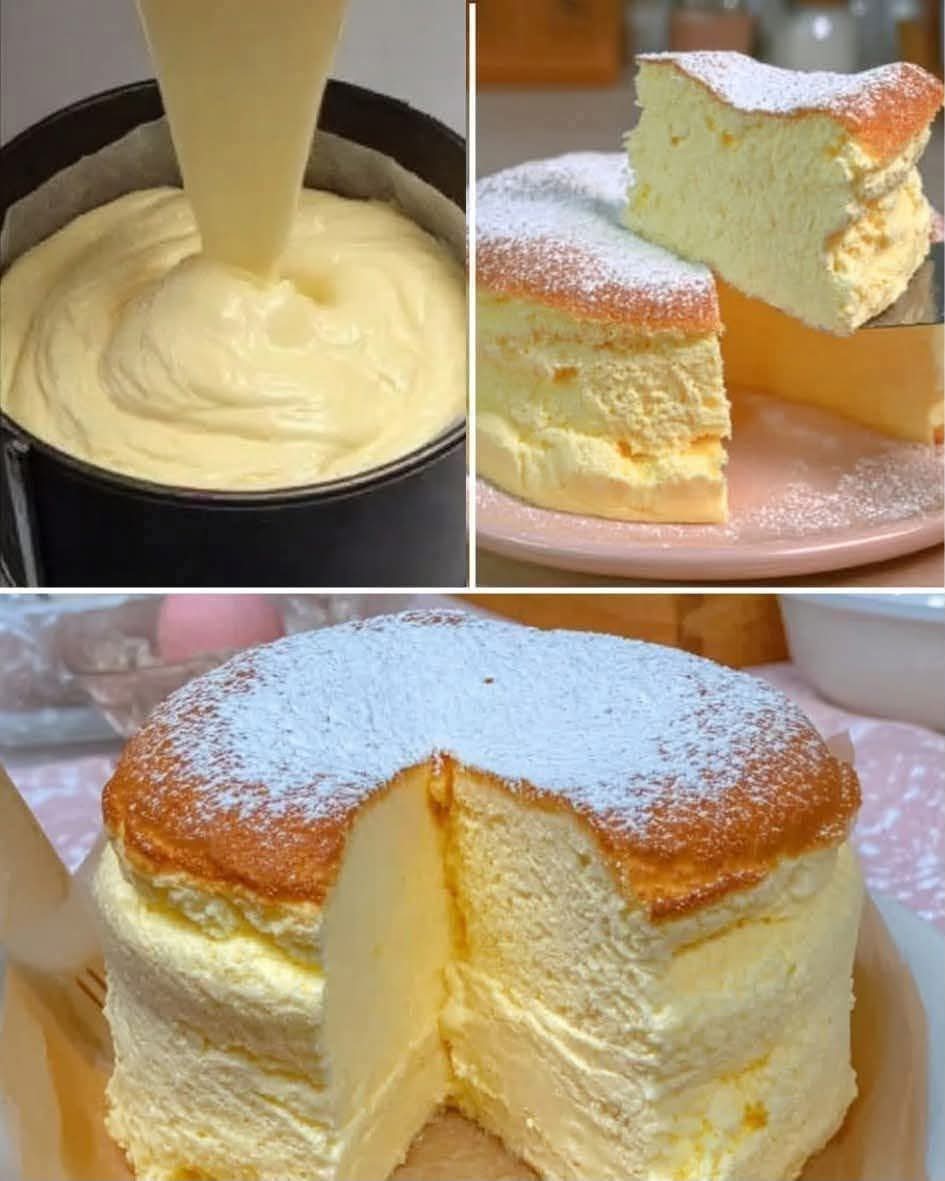
photo, this looks like a Japanese-style cotton cheesecake: a very soft, airy cheesecake with a lightly golden top, creamy center, and delicate sponge-like texture. It is lighter than a traditional New York cheesecake and has a beautiful melt-in-the-mouth texture.
1. Introduction
Japanese cotton cheesecake is one of the most delicate and beautiful cheesecake styles. Unlike a dense traditional cheesecake, this cake is made light and fluffy by carefully folding whipped egg whites into a cream-cheese batter.
The finished cake should be soft enough to gently tremble when you move the pan. The outside becomes lightly golden while the inside remains pale, creamy, moist, and airy. A small amount of powdered sugar on top gives it a simple and elegant appearance.
The secret to a successful Japanese cheesecake is not only the ingredients. The mixing technique, oven temperature, and water-bath baking method are equally important. If the egg whites are over-whipped or folded too aggressively, the cake can become dense or crack. If the oven is too hot, the outside may brown before the center has finished cooking.
This recipe makes approximately 8–10 portions.
2. Ingredients
For the cheesecake
- 250 g cream cheese
- 50 g unsalted butter
- 100 ml whole milk
- 6 large eggs
- 100 g granulated sugar
- 60 g cake flour
- 20 g cornstarch
- 1 teaspoon vanilla extract
- 1 tablespoon lemon juice
- 1 teaspoon lemon zest, optional
- 1 pinch of salt
For finishing
- Powdered sugar, for dusting
- Fresh strawberries or other berries, optional
- Whipped cream, optional
- Mint leaves, optional
For the water bath
- Hot water
- A large baking tray
- Aluminum foil if your cake pan is not completely watertight
3. Equipment
You will need:
- 20 cm round cake pan
- Two mixing bowls
- Whisk
- Electric hand mixer
- Rubber spatula
- Fine sieve
- Saucepan
- Baking tray
- Baking paper
- Wire cooling rack
A removable-bottom cake pan can work, but it must be wrapped very carefully with aluminum foil so that water cannot enter.
4. Preparation of the Pan
First, prepare the cake pan.
Cut a circle of baking paper to fit the bottom of the pan. You can also prepare strips of baking paper for the sides.
Lightly grease the inside of the pan with butter. Place the baking paper inside and lightly grease the paper as well.
If using a springform or removable-bottom pan, wrap the outside tightly with two or three layers of aluminum foil. This prevents water from the water bath from entering the cake.
The water bath is very important because it creates a humid and gentle baking environment. This helps the cheesecake remain soft and prevents the edges from becoming dry.
5. Making the Cream Cheese Mixture
Place the cream cheese, butter, and milk into a saucepan.
Heat the mixture over low heat.
Do not allow it to boil.
Stir continuously until the cream cheese and butter have completely melted and the mixture becomes smooth.
Remove the saucepan from the heat.
Allow it to cool slightly.
Add the egg yolks one at a time, whisking after each addition.
Then add:
- vanilla extract
- lemon juice
- lemon zest if using
Mix everything until smooth.
The lemon juice is particularly useful because it balances the richness of the cream cheese and gives the cheesecake a fresh flavor.
6. Sifting the Dry Ingredients
In a separate bowl, combine:
- 60 g cake flour
- 20 g cornstarch
- pinch of salt
Sift the flour and cornstarch into the cream-cheese mixture.
Do not simply dump the flour into the bowl. Sifting helps prevent lumps and produces a smoother batter.
Whisk gently until everything is incorporated.
Do not overmix.
The batter should be smooth, relatively thin, and free of visible flour.
7. Preparing the Egg Whites
Now comes the most important part of the recipe.
Separate the six eggs carefully.
Place the egg whites into a completely clean and dry mixing bowl.
Even a small amount of egg yolk or grease can make it difficult to whip the whites properly.
Begin beating the egg whites at medium speed.
When they become foamy, gradually add the sugar.
Add the sugar in approximately three portions rather than all at once.
Continue beating until the egg whites form soft to medium peaks.
You do not want extremely stiff, dry egg whites.
When you lift the whisk, the peak should stand but the tip should gently bend over.
This consistency helps create the characteristic soft texture of Japanese cotton cheesecake.
8. Folding the Egg Whites
Add approximately one-third of the whipped egg whites to the cream-cheese mixture.
Use a rubber spatula to fold gently.
Start from the bottom of the bowl and bring the mixture upward.
Then add another third of the egg whites.
Fold again.
Finally, add the remaining egg whites.
Continue folding gently until the batter is uniform.
Important:
Do not stir aggressively.
The air trapped inside the whipped egg whites is what gives the cheesecake its fluffy structure.
If you destroy too much of this air, the cake will become heavy and dense.
However, do not leave large pieces of egg white either. The final batter should be smooth and evenly combined.
9. Pouring the Batter
Pour the batter slowly into the prepared cake pan.
Tap the pan very gently against the countertop once or twice to remove large air bubbles.
Do not hit it aggressively.
Place the cake pan inside the larger baking tray.
Pour hot water into the larger tray until it reaches approximately 1–2 cm up the side of the cake pan.
This is the water bath.
10. Baking
Preheat the oven to approximately 160°C.
Place the cheesecake into the oven.
Bake at 160°C for about 20 minutes.
Then reduce the temperature to approximately 140°C and continue baking for another 40–50 minutes.
The exact baking time depends on your oven and cake pan.
The cheesecake is ready when:
- The top is lightly golden.
- The center is set but still has a gentle wobble.
- A toothpick inserted into the center comes out mostly clean.
- The cake has risen beautifully.
Avoid opening the oven repeatedly because sudden temperature changes can cause the cake to collapse.
11. Cooling the Cheesecake
When the cheesecake is finished, turn off the oven.
Leave the cheesecake inside with the oven door slightly open for approximately 10–15 minutes.
This gradual cooling helps prevent a sudden collapse.
Remove the cake from the oven.
Take it out of the water bath and allow it to cool.
Carefully remove the cake from the pan.
You can serve it slightly warm for an especially soft texture, or refrigerate it for several hours if you prefer a firmer, creamier cheesecake.
12. Finishing and Decoration
Once completely cooled, place the cheesecake on a serving plate.
Dust the top lightly with powdered sugar.
For a beautiful presentation, you can serve each slice with:
- Fresh strawberries
- Blueberries
- Raspberries
- Whipped cream
- Strawberry sauce
- Raspberry coulis
- Vanilla ice cream
For the appearance shown in your photo, keep the decoration simple: a generous but light dusting of powdered sugar is enough.
13. How to Cut the Cake
For clean slices, use a sharp knife.
For an especially beautiful presentation, dip the knife into hot water, wipe it dry, and then cut the cheesecake.
Repeat this process between slices.
This gives you smooth, clean cuts and shows the beautiful fluffy interior.
When you press gently on the slice, the cheesecake should feel soft and springy.
14. Important Tips for Success
Tip 1 — Use room-temperature cream cheese
Room-temperature cream cheese mixes much more easily and reduces lumps.
Tip 2 — Do not over-whip the egg whites
Very stiff egg whites can make folding difficult and may create a rough or cracked cheesecake.
Soft-to-medium peaks are better.
Tip 3 — Fold gently
The whipped egg whites contain the air responsible for the cake’s light texture.
Tip 4 — Use a water bath
The water bath provides gentle heat and moisture, helping the cheesecake bake evenly.
Tip 5 — Do not bake at excessive temperature
High heat can cause the cheesecake to rise too quickly and then collapse.
It can also create a dark, cracked surface.
Tip 6 — Cool gradually
A sudden change from a hot oven to cold air can cause the cake to shrink quickly.
Tip 7 — Don’t worry about a little shrinking
Japanese cotton cheesecake naturally loses some volume as it cools. A small amount of shrinking is normal.
15. Troubleshooting
Why did my cheesecake collapse?
Possible reasons include:
- Egg whites were not whipped correctly.
- The batter was overmixed.
- The cheesecake was underbaked.
- The oven temperature changed suddenly.
- The cake was removed from the oven too quickly.
Why is the cheesecake dense?
The most common reason is losing too much air during the folding process.
Make sure you fold the egg whites gently.
Why did the top crack?
The oven may have been too hot.
Try lowering the temperature slightly and making sure you are using a proper water bath.
Why is the bottom wet?
There may have been too much water in the water bath or water may have entered the cake pan.
Wrap the pan carefully with aluminum foil if necessary.
16. Serving Suggestions
Japanese cotton cheesecake is delicious by itself, but you can make it even more special.
For a classic presentation, dust it with powdered sugar and serve it with fresh berries.
For a richer dessert, add a small spoonful of whipped cream.
For a fruit version, serve it with strawberry, raspberry, mango, or passion-fruit sauce.
For a café-style presentation, place one slice in the center of a plate, dust powdered sugar around it, add a few berries, and finish with a small mint leaf.
17. Storage
Store the cheesecake in an airtight container in the refrigerator.
It is best consumed within 3–4 days.
The texture becomes slightly firmer after refrigeration, but it remains creamy and delicious.
If you want a softer texture, remove a slice from the refrigerator and allow it to sit at room temperature for approximately 15–20 minutes before serving.
You can also freeze individual slices. Wrap them carefully in plastic wrap and place them in a freezer-safe container. Thaw them slowly in the refrigerator.
18. Short Professional Recipe Summary
Japanese Cotton Cheesecake
A light and delicate cheesecake made with cream cheese, milk, butter, eggs, flour, cornstarch, sugar, vanilla, and lemon. The cream cheese mixture is combined with carefully whipped egg whites to create a fluffy, airy texture. The cake is baked gently in a water bath until the surface becomes golden and the center remains soft and creamy. After gradual cooling, the cheesecake is finished with powdered sugar and served plain or with fresh fruit.
19. Conclusion
Japanese cotton cheesecake is a perfect example of how simple ingredients can create an elegant dessert when the technique is carefully controlled. The combination of cream cheese, eggs, milk, butter, flour, and sugar produces a cake that is richer than a sponge cake but much lighter than a traditional cheesecake.
The most important elements are the whipped egg whites, gentle folding, low-temperature baking, and water bath. These steps create the soft, fluffy texture visible in your photo.
When finished correctly, the cheesecake should have a lightly golden top, a delicate crust, and a pale, creamy interior that feels almost like a cloud. A simple dusting of powdered sugar completes the presentation.
Final result: a soft, fluffy, creamy, melt-in-the-mouth Japanese cheesecake that is perfect for breakfast, afternoon tea, dessert, or a professional pastry presentation. 🍰✨